
Interlinking behaviour, technology, and roles in women rice seed producer groups of Bangladesh

This comparative case study examined how organizational behavior, the utilization of digital technology, and the value chain roles of members collectively impacted the success of women-led rice seed producer groups (WLRSPGs) in Bangladesh. Five unique groups across three geographical divisions of the country were analyzed through a mixed-methods approach utilizing qualitative case studies and comparative scoring matrices, and compared leadership styles, group cohesion, communication patterns, adaptability, digital tool use, and functional roles. The case study examined the proposition that groups exhibiting transformational leadership, along with high cohesion and effective communication, significant adoption of digital tools, and broader functional roles, tend to achieve greater market reach, enhanced operational efficiency, and stronger future readiness. Findings suggested that while transformational leadership and technology adoption fostered innovation and resilience, they did not directly correlate with higher seed income. Financial success in rice seed entrepreneurship was primarily driven by producing certified seeds for regional and national markets, with members having greater control over the value chain. Additionally, seed producer-only groups exhibited higher rice seed production, which correlated with higher seed income; in contrast, federated groups relied on non-seed income and diversification. The research highlights the importance of product and market decisions and greater roles in the value chain alongside skill development and digital literacy in empowering women in agriculture, providing valuable insights for policymakers and development practitioners.
- Published in NEW PUBLICATIONS
Socio-economic dimensions of smallholder agroforestry

Agroforestry is increasingly understood as a multifunctional land-use system that has the capacity to improve the livelihoods of smallholders and solve the interconnected problems of climate change, food insecurity and ecosystem degradation. Although there is an increasing body of literature, there are still disparate gaps in the available evidence on the socio-economic aspects of smallholder agroforestry across various disciplines, contexts, and methodological backgrounds that hinder cumulative knowledge and policy implications. The present study is a mixed-method systematic review, which combines bibliometric science mapping with a Theory-Context-Characteristics-Methodology (TCCM) framework to synthesize and critically evaluate the literature. According to a strictly filtered database of peer-reviewed articles in Scopus and Web of Science, the bibliometric analysis identifies trends in publications, intellectual structures, the development of the themes, and geographical patterns, and the TCCM synthesis identifies prevailing theoretical perspectives, contextual and socio-economic factors, and methodologies. The findings indicate that publications have grown significantly since 2020, and it is predominantly on income effects, adoption behaviour, and livelihood outcomes, particularly in the Global South. The literature is, however, conceptually narrow, geographically and commodity-biased, and primarily based on cross-sectional quantitative designs. Significant gaps remain in theory-context integration, consideration of smallholder heterogeneity, and examination of long-term socio-economic dynamics. The identified prevalence of cross-sectional quantitative designs, the focus of the studies in certain areas of the Global South, and this review contribute to the necessity of longitudinal, multi-scalar, and theory-driven research designs. Addressing the limited attention to smallholder heterogeneity and institutional contexts can improve the design of agroforestry policies that are inclusive of socio-economic and long-term livelihood contexts. These findings provide future research directions, theoretical extensions, and conceptual advancements that are aimed at strengthening the socio-economic sustainability of smallholder agroforestry systems.
- Published in NEW PUBLICATIONS
Working Together to End Child Labour in Agriculture
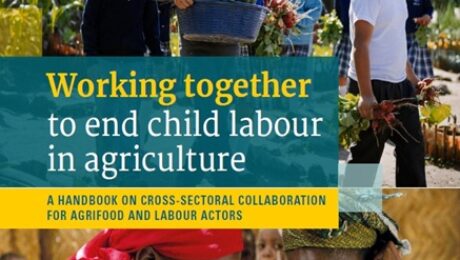
This FAO handbook explores the urgent need for cross-sectoral collaboration to eliminate child labour in agriculture. It highlights the roles of agrifood and labour actors, explains the root causes of child labour in rural communities, and provides practical tools, policy guidance, and field-based lessons to strengthen coordinated action. A valuable resource for policymakers, researchers, extension professionals, development practitioners, and organizations working toward sustainable agrifood systems and children’s rights.
- Published in NEW PUBLICATIONS
The World of organic Agriculture – Statistics and Emerging Trends 2026
In a world marked by mounting geopolitical tensions, supply chain disruptions and accelerating climate impacts, our food systems are under increasing strain. In this context, this edition of The World of Organic Agriculture shows that, despite economic headwinds and political uncertainty, the global organic sector continues to grow. Ongoing and new conflicts, heightened geopolitical rivalries, trade frictions, energy price volatility and extreme weather events are reshaping flows of food, feed and inputs and raising production risks. These dynamics particularly affect smallholder farmers. Organic and agroecological approaches—based on diversified production systems, healthier soils and lower dependence on synthetic inputs and imported fertilisers—can offer a way to increase resilience, reduce climate and environmental risks and sustain livelihoods in both advanced and emerging economies.
- Published in NEW PUBLICATIONS
Antimicrobial and other aquamedicine use for disease treatment in pond-based commercial tilapia farms in Bangladesh

This study addresses the limited information on use of antimicrobials and other chemical use in commercial tilapia farms in Bangladesh. A retrospective cross-sectional survey was conducted in November 2022 in the Mymensingh district, a major tilapia production hub.
The use of both antimicrobial and non-antimicrobial medicine varied significantly by location, being significantly less likely observed in Tarakanda (p < 0.05) and Fulbaria (p < 0.01), suggesting location-specific differences in disease management. The presence of clinical signs was significantly associated with increased use of both antimicrobials, non-antimicrobial medicine and use of overall aquamedicine (p < 0.001), while longer cultivation durations showed a weak association with reduced AMU. Imprudent use of antimicrobials and other chemicals may pose One Health risks, including disruption of pond microbial ecosystems, AMR development, chemical residues, and occupational hazards. In-depth qualitative studies are needed to further understand and optimize antimicrobial and other chemical use practices and determine how tilapia farmers may benefit from improved biosecurity, training, and veterinary access.
- Published in INDIA
Food Subsidies in India: Revisiting the Estimates
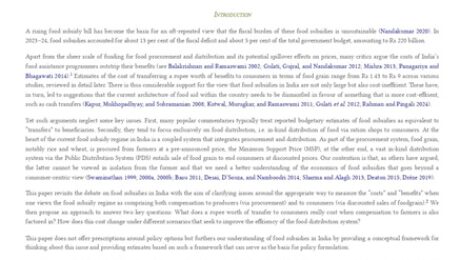
There is a view that the fiscal burden of food subsidies in India is unsustainable. Yet popular debate and discussion around the costs of these food subsidies, relative to their benefits, are misleading for two reasons. First, they typically treat reported budgetary subsidy estimates—i.e. the fiscal cost to the government of the distribution of food via ration shops—as equivalent to “transfers” to beneficiaries. Secondly, they tend to focus exclusively on consumers. In doing so, they neglect the two-part nature of the food distribution system, which includes payments to farmers at the time of procurement. This paper examines ways of measuring the costs and value of the food subsidy. We present estimates that combine the implicit value of benefits to consumers arising from the reduced price of grain sold to consumers via ration shops, with implicit benefits to farmers, in terms of the price difference between what farmers are paid by the government and what they would have obtained in the open market. This approach shows that each rupee of the “food subsidy” reported in government accounts represents a transfer worth Rs 1.29 to consumers and farmers, on average, over the period 2001–02 to 2022–23. That is, each rupee transferred to these groups is associated with a cost of Rs 0.79 to the government.
- Published in INDIA
Leadership Development for Fast-Tracking Participatory Groundwater Management (PGWM) in India
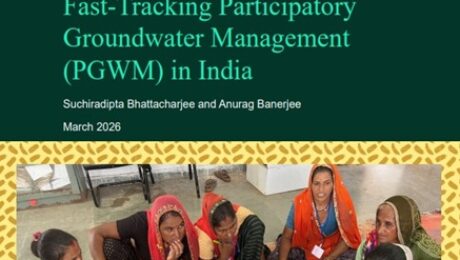
This technical brief explores the role of leadership development in accelerating Participatory Groundwater Management (PGWM) in India. It highlights training initiatives designed to build leadership capacities among community resource persons, government officials, and civil society actors involved in groundwater governance. Drawing on field experiences and training programs, the document discusses strategies for strengthening local leadership, improving community participation, and enhancing collective decision-making for sustainable groundwater use. The brief contributes to policy discussions on strengthening water governance and promoting community-driven approaches to groundwater management.
- Published in NEW PUBLICATIONS
Empowering Farmers: Natural Farming Training Toolkit & Best Practices Guide
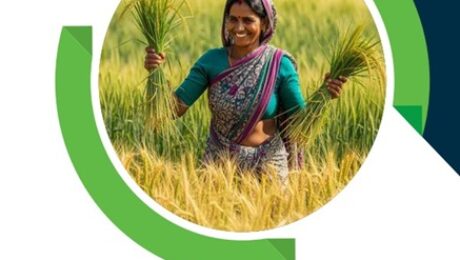
Empowering Farmers: Natural Farming Training Toolkit & Best Practices Guide is a practical training manual designed for farmers, extension officers, and agricultural trainers to promote sustainable and chemical-free farming practices. The manual provides step-by-step guidance on natural farming principles, field practices, soil health management, crop protection, and farmer capacity building. Developed with inputs from agricultural institutions, Krishi Vigyan Kendras, and practitioners, the toolkit aims to strengthen farmers’ knowledge and enable wider adoption of environmentally sustainable and economically viable natural farming systems across India.
- Published in NEW PUBLICATIONS
Making Agricultural Drones Accessible to Philippine Rice Farmers
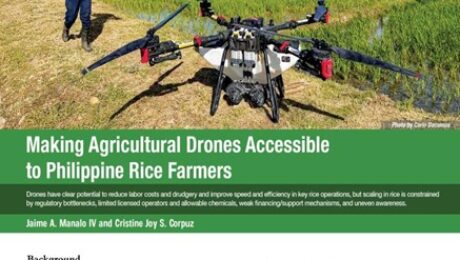
This study looked into the various aspects that could influence the uptake of agricultural drones in rice in the Philippines with the aim of identifying courses of action to assist in the massive deployment of drones in Philippine rice fields—a move expected to enhance profitability among rice farmers.
- Published in NEW PUBLICATIONS
Farmers’ Characteristics and Constraints in T-aman Rice Cultivation in Bangladesh
Transplanted Aman (T-aman) rice remains integral to household food access and livelihood resilience in northern Bangladesh, yet its production remains constrained by multiple agronomic and socio-economic challenges. This study examined the intensity of constraints encountered by producers involved in T-aman rice production and analysed their relationships with selected farmer attributes. Information was gathered from randomly selected farmers using a pretested structured interview schedule during October 2012. Farmers’ problem confrontation was assessed using a four-point scale across 15 identified constraints, and a PCI was done to classify problem severity. Pearson’s Coefficient was applied to observe linkages between problem confrontation and farmers’ socio-economic and communication characteristics. Results showed that 72.8% of farmers experienced a medium level of problems, while 27.2% faced a high level of problems in T-aman cultivation. High production cost ranked as the most severe constraint. The rest have negative or no significant association. The findings highlight the importance of strengthening farmer knowledge, extension services, and input quality regulation to reduce production constraints and enhance the sustainability of T-aman rice cultivation in vulnerable regions of Bangladesh.
- Published in BANGLADESH, NEW PUBLICATIONS