
Tool for Agroecology Performance Evaluation: Process of Development and Guidelines for Application

This document provides guidance on how to assess agroecology by carrying out a diagnostic of production systems with regard to various dimensions (environmental, social, economic) and in a variety of contexts (production systems, communities, territories, agro-ecological zones, etc.).
- Published in GUIDE/TOOLS/MANUALS, MONITORING & EVALUATION
A Framework for Analyzing Pluralistic Agricultural Advisory Services Worldwide
The analytical framework developed in the paper “disentangles” the major characteristics of agricultural advisory services on which policy decisions have to be made: (1) governance structures, (2) capacity, management and organization, and (3) advisory methods. The framework identifies four sets of frame conditions that need to be considered when deciding on these characteristics: the policy environment, the capacity of potential service providers, the type of farming systems and the market access of farm households; and the nature of the local communities, including their ability to cooperate. The framework suggests an impact chain approach to analyze the performance and the impact of agricultural advisory services
- Published in MONITORING & EVALUATION
A Scoring Tool to Generate Evidence on Performance and Outcomes-FAO 2022
To enable evidence based and informed policy and investment decision for extension and advisory systems, the EAS-Yardstick (EAS-Y) has been developed through a consultative expert process. It constitutes a holistic scoring tool based on a comprehensive set of metrics that can capture all the nuances of the pluralistic EAS. Metrics are organized into two modules, related to EAS performance and to EAS outcomes, each subdivided into key EAS topics. These cover elements of the EAS enabling environment, scope and provision of services, and coordination, collaboration and learning in the system. At the outcome level, topics include the acquisition of skills, changes in behaviours and livelihood transformations. All metrics are operationalized through a scoring mechanism. EAS-Y is digitally enabled through the Kobo toolbox and is used for participatory assessments in various contexts. Assessments can support a systematic cross country analysis, complementing findings from more specific impact evaluations of EAS interventions or in-depth process evaluations. As such, it contributes to substantially enhance EAS system performance and outcomes by guiding investment and policy decisions.
- Published in CAPACITY DEVELOPMENT, MONITORING & EVALUATION
Comprehensive Assessment of National Extension and Advisory Service Systems- An operational guide FAO (2022)
Extension and advisory services (EAS) play a key role in facilitating innovation processes, empowering marginalized groups through capacity development, and linking farmers with markets. EAS are increasingly provided by a range of actors and funded from diverse sources. With the broadened scope of EAS and the growing complexity of the system, the quantitative performance indicators used in the past (for example related to investment, staffing or productivity) are no longer adequate to assess the performance of EAS systems. This operational guide meets the longstanding demand for guidance on undertaking such a comprehensive assessment of national EAS systems. It provides detailed directions on how to organize the entire process, from preparation to implementation and consolidation. Its use will help identify gaps and entry points for targeting investments and realigning policies for transforming EAS.
- Published in CAPACITY DEVELOPMENT, MONITORING & EVALUATION
A decision guide for rural advisory methods

This decision guide is intended to help extension professionals and their organizations make informed decisions about which extension method and approach to use for providing information, technologies and services to rural producers and to facilitate interactions and knowledge flow. Expected users include field-based rural advisors, extension managers and programme planners.
- Published in CONCEPTS AND PRACTICES, GUIDE/TOOLS/MANUALS
The New Extensionist Core Competencies for individuals

Following the publication of the New Extensionist, the GFRAS Consortium on Education and Training collected existing curricula used in different countries, conducted an analysis of the competencies that the curricula focused on and organised consultations with experts to identify the core competencies needed in extension today. The experts then agreed on a listing of core competencies that the New Extensionist professional should have. This brief has these details.
- Published in CAPACITY DEVELOPMENT
Value Chain Toolkit- Harnessing the Power of Markets to Drive Change

The Value chain tool kit provides methods to support male and female farmers in the “Build to Grow to Prosper” phases of the CRS Pathway to Prosperity (Figure 1). Through this work CRS is striving to achieve industry leadership in value chain service delivery and influence that is gender-sensitive. Value chain programming is now synonymous with agricultural development and CRS aims to adopt this approach across our project portfolio.
- Published in GUIDE/TOOLS/MANUALS, VALUE CHAIN / MARKETS
Toolkit for value chain analysis and market development integrating climate resilience and gender responsiveness

This toolkit intends to provide policy makers, planners, project developers, technical advisors and implementers at local, regional or national level, with good practices of climate-resilient and gender-responsive value chain development.1 It aims to act as a repository of relevant tools and methodologies for identifying relevant stakeholders and engaging with them to collect data and analyse it to design interventions. Climate change threatens agricultural value chains and having a genderresponsive value chain approach is useful in analysing the climate risks, as it looks at stages during and beyond production, while using a more systemic approach to risk management.
- Published in GUIDE/TOOLS/MANUALS, VALUE CHAIN / MARKETS
Agricultural Extension and Advisory Services in Support of Climate Change Adaptation and Mitigation: An Evidence Review
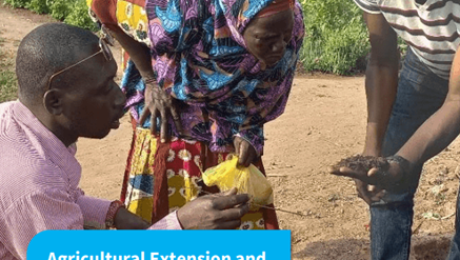
Agricultural extension and advisory services (EAS) is an umbrella term that refers to organizations, individuals and activities that supply information and services required by farmers and other agricultural actors to develop their own technical, organizational, and managerial capacities for livelihoods and well-being improvement. Public and private sector EAS are on the frontline in supporting smallholder farmers to adapt to the changing climate as they engage in field level activities and work closely with farmers to provide new technologies, technical information, knowledge, and skills, as well as linking them to other rural actors. EAS also work with policy makers and development program implementers to disseminate information about and put into practice new agricultural interventions, programs, and policies.
- Published in CLIMATE CHANGE
Climate Change and Agricultural Extension and Advisory Services
Rising temperatures, longer droughts, more severe storms, warming oceans, and recurring floods are already threatening global agriculture and food security. Most smallholder farmers in middle- and lowincome countries have limited abilities to respond and adapt to these climate risks. While highly vulnerable to climate change, agriculture is also a major source of greenhouse gas (GHG) emissions. To strengthen the resilience of agriculture to changing climate, a two-pronged approach that supports adaptation – adjusting to actual or expected future climate change – and promotes mitigation – reducing greenhouse gases or enhancing accumulation and storage of GHG – is needed. Promoting these strategies at scale involves changing the behavior, strategies, and agricultural practices of millions of agricultural producers.
This brief discusses policy-level changes to enhance and strengthen the role and functioning of extension and advisory services (EAS) in addressing climate change adaptation and mitigation.
- Published in CLIMATE CHANGE