Empowering rural lives: An assessment of vocational training in Eastern Nepal

This publication is an assessment of vocational training in Nepal through the lens of skills acquisition and its applicability in the job market; employment status, career progression and livelihood of graduates, and the relevance of such training programs.
- Published in NEPAL
Rethinking gender mainstreaming in agricultural innovation policy in Nepal
Gender mainstreaming has been prioritised within the national agricultural policies of many countries, including Nepal. Yet gender mainstreaming at the national policy level does not always work to effect change when policies are implemented at the local scale. In less-developed nations such as Nepal, it is rare to find a critical analysis of the mainstreaming process and its successes or failures. This paper employs a critical gender analysis approach to examine the gender mainstreaming efforts in Nepal as they move from agricultural policies to practices. The research involved a structured review of 10 key national agricultural policy documents, 14 key informant interviews, and two focus group discussions with female and male smallholder farmers. Results suggest that gender mainstreaming in national agricultural policy and practice has largely failed. The creation of the Gender Equity and Social Inclusion (GESI) section within the Ministry of Agriculture and Livestock Development is paradoxical to gender-responsive agricultural innovation because it has received limited human and financial resources with an expectation for women to manage this policy development in informal and largely unrecognized ways. At the regional and local levels, implementation of fundamental gender equity and social inclusion procedures—such as gender-responsive planning and budgeting—has become staff responsibility without requisite formal training, gender sensitization, and follow-up. In Nepal, women as smallholder farmers or agricultural labourers are recognized as a vulnerable group in need of social protection, but the welfare approach to gender mainstreaming has achieved little in terms of gender equity, social inclusion, and agricultural sustainability. This paper concludes that what is generally missing is a systemic transformation of gender roles and relations in agriculture, with policies that would support rural women’s empowerment through the provision of economic and political rights and entitlement to productive resources.
- Published in NEPAL
Minutes of consultation workshop on the project consortium for Scaling-up Climate Smart Agriculture in South Asia (C-SUCSeS): Brainstorming the challenges and opportunities of tackling climate change in the region
Consortium for Scaling-up Climate Smart Agriculture in South Asia (C-SUCSeS) is a four-year joint initiative between South Asian Association for Regional Cooperation (SAARC) Agriculture Center (SAC), International Food Policy Research Institute (IFPRI), International Fund for Agricultural Development (IFAD), and the SAARC Development Fund (SDF). The program aims to foster partnership and cooperation between SAARC, National Agricultural Research and Extension Systems (NARES), IFPRI, and SAARC governments on the Climate-Smart Agriculture (CSA) agenda. The project also intends to support agricultural researchers’ to generate and facilitate delivery of technological solutions to smallholder and women farmers, with a specific priority on the intensification and resilience of smallholder agriculture, contributing, inter alia, to increasing water management efficiency, promote innovative, pro-poor approaches and technologies with demonstrated scaling-up potential, strengthen partners’ institutional and policy capacities, enhance policy engagement, and generate and share knowledge.
- Published in INDIA
Investing in rural people in India
IFAD has been working in India for more than 40 years. The current country strategic opportunities programme is fully aligned with the government’s policy framework.
During the period 2018-2024, IFAD will accompany government efforts to make smallholder farm systems remunerative, sustainable and resilient to climate change and price shocks.
- Published in INDIA
Gender and Rural Advisory Services Assessment in Pakistan
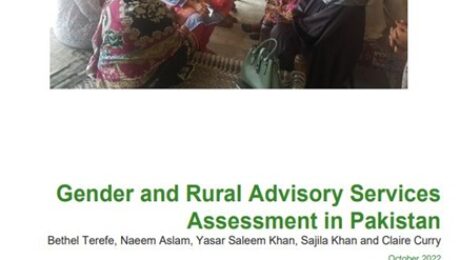
Women farmers in developing countries, including Pakistan, face challenges in accessing agriculture extension advisory services, with most of those services geared towards the needs of male farmers. Alongside other challenges faced by women farmers, this contributes to the gender gap in agriculture productivity in developing countries, whereby women-managed farms are 20–30% less productive than farms managed by men. It has been estimated that closing this gap would help to boost agriculture production by 2.5–4%, improve food security and improve the welfare of rural households (FAO, 2011).
In the context of the launch of CABI’s new PlantwisePlus programme in Pakistan, which aims to enhance the knowledge and uptake of climate-smart plant health practices through responsive digital advisory tools, this report presents the results of an assessment of the current state of gender-sensitive extension services in Pakistan, and provides recommendations for making improvements.
- Published in PAKISTAN
Gender differences in use and preferences of agricultural information sources in Pakistan
This study interviewed 401 male/female individuals in farm households in Jhang and Bahawalpur district of Punjab, Pakistan in 2016.
Findings: Men and women farmers’ use and preferences in accessing information sources are extremely different. Women hardly use sources for agricultural information, and value interpersonal communication from informal sources. In contrast, men use and value official agencies more. Radio, surprisingly, was very rarely used, contradicting previous findings of research elsewhere. Age and literacy affect differences between women more than it does between men, particularly for convenient locations to access information. Practical implications The study identified and refined major gender differences regarding use and preference for agricultural information in relation to age and literacy, and helps to articulate options to improve gender equality of access to agricultural information in Pakistan.
Theoretical implications: The focus and outcomes regarding gender intersecting with age and literacy in agricultural information access imply the need for more refined socio-economic models, discerning and interrelating gender and other social dimensions beyond the standard of male-headed households.
Originality/value: This paper adds to the growing body of evidence on information access according to gender, highlighting the need to investigate deeper socio-cultural issues around age and literacy.
- Published in PAKISTAN
Pakistan | 2021 Humanitarian Response Plan
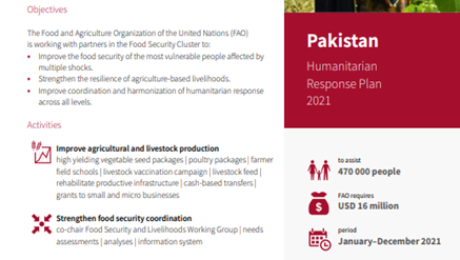
The food security situation in Pakistan has significantly worsened, mainly due to drought, floods, desert locust and conflict, which have triggered population displacements and reduced agricultural production.The number of people in need of food security and livelihoods assistance is projected to increase to over 6.1 million people in June 2021, making it critical to provide integrated agricultural support to vulnerable people devastated by multiple shocks.
- Published in PAKISTAN
Dysfunctional Horticulture Value Chains and the Need for Modern Marketing Infrastructure: The Case of Pakistan
This brief presents findings on agricultural wholesale markets in Pakistan and provides recommendations to help develop more efficient production and marketing systems.
The brief provides an overview of Pakistan’s agriculture sector and horticulture value chain, and of four agricultural wholesale markets in Lahore. It proposes ways of improving the management, maintenance, and accessibility of markets, and making the value chain more efficient.
- Published in PAKISTAN
Impact of COVID-19 and Locust Swarms on Farm Households in Sindh, Pakistan: Analysis of Data from a Cross-Sectional Survey
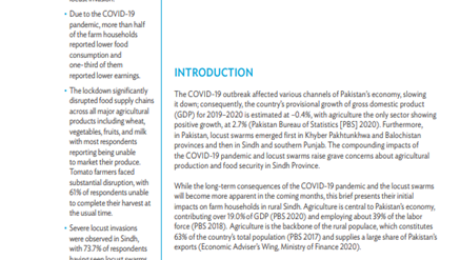
This brief identifies measures to mitigate the impact of the coronavirus disease (COVID-19) pandemic and locust infestation on farm households and the agriculture sector based on findings from a survey in Sindh, Pakistan.
An ADB survey conducted in June 2020 found that the lockdown due to COVID-19 significantly disrupted food supply chains across all major agricultural products in Sindh. Furthermore, severe locust invasions have been observed, with 73.7% of respondents having seen locust swarms in their area. The survey findings outline policy measures that can help farmers cope and adapt to the long-term consequences of the pandemic and locust swarms that affect farm households and agricultural produce.
National agrifood systems and COVID-19 in Pakistan
This report describes: (i) policy measures enacted by the Government of Pakistan to contain the spread of the virus; (ii) policies and measures to stabilize the functioning of agri-food systems; (iii) potential effects of policies on agri-food systems and vulnerable groups. Finally, the profile also assesses longer-term options for agri-food system policies and investments in Pakistan so as to make them more resilient.