
Agricultural development: New perspectives in a changing world
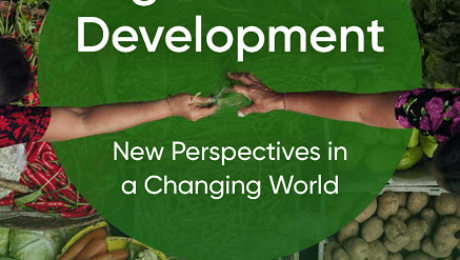
Agricultural Development: New Perspectives in a Changing World is the first comprehensive exploration of key emerging issues facing developing-country agriculture today, from rapid urbanization to rural transformation to climate change. In this four-part volume, top experts offer the latest research in the field of agricultural development. Using new lenses to examine today’s biggest challenges, contributors address topics such as nutrition and health, gender and household decision-making, agrifood value chains, natural resource management, and political economy. The book also covers most developing regions, providing a critical global perspective at a time when many pressing challenges extend beyond national borders. Tying all this together, Agricultural Development explores policy options and strategies for developing sustainable agriculture and reducing food insecurity and malnutrition. The changing global landscape combined with new and better data, technologies, and understanding means that agriculture can and must contribute to a wider range of development outcomes than ever before, including reducing poverty, ensuring adequate nutrition, creating strong food value chains, improving environmental sustainability, and promoting gender equity and equality.
- Published in EXTENSION AND INNOVATION
Multi-faceted impact and outcome of COVID-19 on smallholder agricultural systems

The shock of Coronavirus Disease 2019 (COVID-19) has disrupted food systems worldwide. Such disruption, affecting multiple systems interfaces in smallholder agriculture, is unprecedented and needs to be understood from multi-stakeholder perspectives. The multiple loops of causality in the pathways of impact renders the system outcomes unpredictable. Understanding the nature of such unpredictable pathways is critical to identify present and future systems intervention strategies. Our study aims to explore the multiple pathways of present and future impact created by the pandemic and “Amphan” cyclonic storm on smallholder agricultural systems. Also, we anticipate the behaviour of the systems elements under different realistic scenarios of intervention. We explored the severity and multi-faceted impacts of the pandemic on vulnerable smallholder agricultural production systems through in-depth interactions with key players at the micro-level. It provided contextual information, and revealed critical insights to understand the cascading effect of the pandemic and the cyclone on farm households. We employed thematic analysis of in-depth interviews with multiple stakeholders in Sundarbans areas in eastern India, to identify the present and future systems outcomes caused by the pandemic, and later compounded by “Amphan”. The immediate adaptation strategies of the farmers were engaging family labors, exchanging labors with neighbouring farmers, borrowing money from relatives, accessing free food rations, replacing dead livestock, early harvesting, and reclamation of water bodies. The thematic analysis identified several systems elements, such as harvesting, marketing, labor accessibility, among others, through which the impacts of the pandemic were expressed. Drawing on these outputs, we employed Mental Modeler, a Fuzzy-Logic Cognitive Mapping tool, to develop multi-stakeholder mental models for the smallholder agricultural systems of the region. Analysis of the mental models indicated the centrality of “Kharif” (monsoon) rice production, current farm income, and investment for the next crop cycle to determine the pathways and degree of the dual impact on farm households. Current household expenditure, livestock, and soil fertility were other central elements in the shared mental model. Scenario analysis with multiple stakeholders suggested enhanced market access and current household income, sustained investment in farming, rapid improvement in affected soil, irrigation water and livestock as the most effective strategies to enhance the resilience of farm families during and after the pandemic. This study may help in formulating short and long-term intervention strategies in the post-pandemic communities, and the methodological approach can be used elsewhere to understand perturbed socio ecological systems to formulate anticipatory intervention strategies based on collective wisdom of stakeholders.
- Published in EXTENSION AND INNOVATION
Scaling Brief #4:Scaling glossary
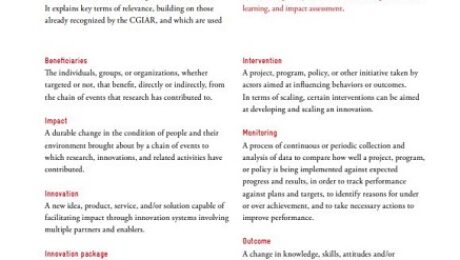
Scaling of innovations is one of the key goals of the new CGIAR 2030 Research and Innovation Strategy and an important driver of the One CGIAR process, which is aimed at stronger integration of its capabilities, knowledge, assets, and people. These policy briefs were developed by CGIAR Science Leaders and scaling specialists to provide guidance for the design and implementation within the CGIAR initiatives around the world. They highlight scaling principles, approaches and tools as well as key terms of relevance to support food system transformation.
- Published in EXTENSION AND INNOVATION
Scaling Brief #3:Scaling approaches and tools
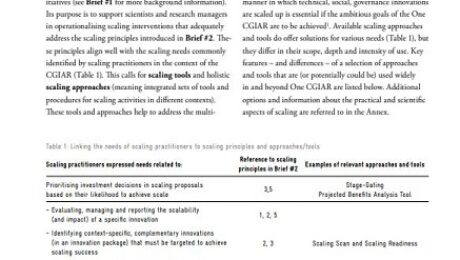
Scaling of innovations is one of the key goals of the new CGIAR 2030 Research and Innovation Strategy and an important driver of the One CGIAR process, which is aimed at stronger integration of its capabilities, knowledge, assets, and people. These policy briefs were developed by CGIAR Science Leaders and scaling specialists to provide guidance for the design and implementation within the CGIAR initiatives around the world. They highlight scaling principles, approaches and tools as well as key terms of relevance to support food system transformation.
- Published in EXTENSION AND INNOVATION
Scaling Brief #2: Scaling Principles
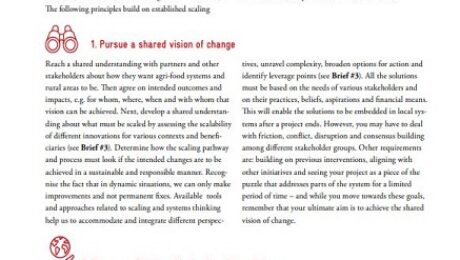
Scaling of innovations is one of the key goals of the new CGIAR 2030 Research and Innovation Strategy and an important driver of the One CGIAR process, which is aimed at stronger integration of its capabilities, knowledge, assets, and people. These policy briefs were developed by CGIAR Science Leaders and scaling specialists to provide guidance for the design and implementation within the CGIAR initiatives around the world. They highlight scaling principles, approaches and tools as well as key terms of relevance to support food system transformation.
- Published in EXTENSION AND INNOVATION
Scaling Brief #1: Scaling Web Conference Series with the CGIAR Science Leaders
Scaling of innovations is one of the key goals of the new CGIAR 2030 Research and Innovation Strategy and an important driver of the One CGIAR process, which is aimed at stronger integration of its capabilities, knowledge, assets, and people. These policy briefs were developed by CGIAR Science Leaders and scaling specialists to provide guidance for the design and implementation within the CGIAR initiatives around the world. They highlight scaling principles, approaches and tools as well as key terms of relevance to support food system transformation.
- Published in EXTENSION AND INNOVATION
State of Social Inclusion in Nepal
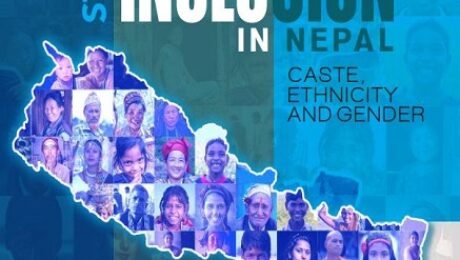
this background, the Central Department of Anthropology (CDA) at Tribhuvan University undertook this study on the “State of Social Inclusion in Nepal (SOSIN).” The study aims to produce a nuanced understanding of the situation and dynamics of social inclusion and gender equality. Using both quantitative surveys and qualitative assessments, this research generates empirical data about the current state of equality and social inclusion in Nepal and allows for the tracking of progress. This research is a sequel to the research project “Social Inclusion Atlas and Ethnographic Profile (SIA-EP)” implemented by the then joint Department of Sociology/Anthropology at TU in 2012-2014 with support from the Norwegian Embassy in Nepal. The SIA-EP established a comprehensive national database disaggregated by gender, caste and ethnicity, built a Multidimensional Social Inclusion Index through re-analysis of major national surveys, and produced profiles of 42 highly marginalized caste/ethnic groups to understand the micro-dynamics of exclusion.
- Published in EXTENSION AND INNOVATION, NEPAL
Multilevel innovation platforms for development of smallholder livestock systems: How effective are they?
There is growing recognition that sustainable development of smallholder agriculture in Sub-Saharan Africa requires a systems approach. One response to this has been applying the agricultural innovation systems concept and the use of Innovation Platforms (IP) as tools for agricultural development. By providing social space and facilitating interactions among farmers, researchers and other stakeholders, IPs can promote collective action and foster innovation.
- Published in EXTENSION AND INNOVATION, LIVESTOCK / FISHERIES
An Evolving Paradigm of Agricultural Mechanization Development: How Much Can Africa Learn from Asia?
Agricultural mechanization in Africa south of the Sahara — especially for small farms and businesses — requires a new paradigm to meet the needs of the continent’s evolving farming systems. Can Asia, with its recent success in adopting mechanization, offer a model for Africa? An Evolving Paradigm of Agricultural Mechanization Development analyzes the experiences of eight Asian and five African countries. The authors explore crucial government roles in boosting and supporting mechanization, from import policies to promotion policies to public good policies. Potential approaches presented to facilitating mechanization in Africa include prioritizing market-led hiring services, eliminating distortions, and developing appropriate technologies for the African context. The role of agricultural mechanization within overall agricultural and rural transformation strategies in Africa is also discussed. The book’s recommendations and insights should be useful to national policymakers and the development community, who can adapt this knowledge to local contexts and use it as a foundation for further research.
- Published in EXTENSION AND INNOVATION
Developing Capacities For Agricultural Innovation Systems
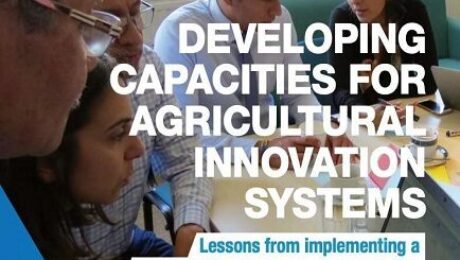
The CDAIS project was designed to strengthen TAP through the development of a common framework for Capacity Development for Agricultural Innovation Systems (CD for AIS) which sets concepts and guidance for the promotion of agricultural innovation system (AIS) thinking and collaborative learning, and for the strengthening of capacities for AIS in tropical countries. The project tested this common framework (or so-called ‘TAP CF’) in eight pilot countries,1 offering a variety of situations across three continents. A transversal analysis of the project outcomes therefore intended to ‘validate’ the common framework, meaning to verify hypotheses underpinning the TAP CF and to verify how changes happened in the eight countries in relation with the mode of operationalization of the TAP CF by the CDAIS project. In other words, the transversal analysis sought to understand how the project produced outcomes, what these outcomes were in each country, so as to propose recommendations for upgrading the TAP Common Framework across its theoretical and practical dimensions.
- Published in EXTENSION AND INNOVATION