
Transforming Food Systems: Pathways for Country-led Innovation

The need to urgently transition food systems to net-zero, nature-positive that can nourish all people, leaving no one behind is more critical than ever. The COVID-19 pandemic has furthered deepened complex challenges we already face from hunger and nutrition, climate and nature, and societal inequity. Innovation offers a profound opportunity to achieve these transitions and help unlock challenges across food systems. The white paper ‘Transforming Food Systems: Pathways for Country-led Innovation’, published by the World Economic Forum Food Systems Initiative and the Food and Agriculture Organization of the United Nations (FAO), presents an action-oriented roadmap for countries looking to accelerate and scale inclusive innovation that meet the needs of all stakeholders in the food system and support countries to invest in their capability to innovate. The roadmap builds on the work of the Innovation Lever of Change, a key component of the UN Food Systems Summit, hosted by UN Secretary-General António Guterres, in September 2021. The Innovation Lever convened a diverse community of nearly 80 organizational partners representing the public, private and social sectors who promoted the adoption of a wider, more holistic view of innovation – one that is inclusive of local and traditional knowledge; mobilizes national innovation ecosystems, catalyzes institutional and social innovation; and employs fit for purpose technologies such as the power of data and digital solutions.
- Published in EXTENSION AND INNOVATION
Documenting and scaling up knowledge and innovations – Guidelines and templates
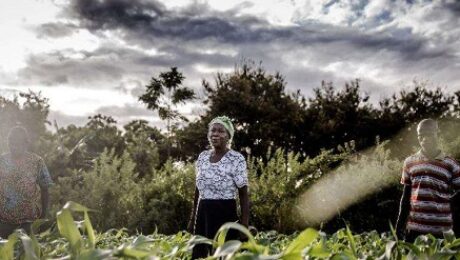
Assessing or understanding the agriculture innovation system (AIS) is an essential step to better understand the needs, new skills and functions needed by the actors and the system. To accelerate the uptake of innovation and progress towards eradicating poverty, there is an urgent need for well-coordinated, demand-driven, and market-oriented information, knowledge, technologies and services.
This document includes a set of information, templates and resources that aim to assist agricultural Innovation systems actors, stakeholders, producers, farmers to develop and share impactful stories. It guides actors and organizations across all sectors in the innovation system to collect and document case studies, success stories, good practices and lessons learned from the project initiatives, trainings and others actions. It highlights scaling-up elements so that other actors can replicate these innovations with a view to scale-up, particularly the stakeholders and actors involved in the DeSira project, through knowledge exchange and sharing.
- Published in EXTENSION AND INNOVATION
Effective approaches and instruments for research and innovation for sustainable agrifood systems
The traditional linear technology transfer model has limited effectiveness in promoting the uptake of technologies and innovations. It fails to account for complexity within the agri-food system, is too simplistic and does not fully consider forward and backward feedback loops in the food system or pay adequate attention to context. There is, therefore, an increasing interest in investors and decision-makers making use of alternative instruments (such as innovation platforms or accelerators) to support innovation processes.
CoSAI commissioned this study to answer the following three key questions:
(1) What types of investment instruments have been tested to support innovation in agri-food systems in the Global South, and how can these be categorized into a working typology?
(2) What is the evidence on how well different instruments have supported SAI’s multiple objectives (e.g. social equality and environmental) at scale and what contextual and design factors affect their success or failure in achieving these objectives (e.g. type of value chain, who participates)?
(3) What advice can be given to innovation investors and practitioners about the instruments selected for different objectives and contexts, and how can selected instruments be designed to achieve better impacts?
- Published in EXTENSION AND INNOVATION
Better instruments and approaches are needed to transform agri-food systems research and innovation
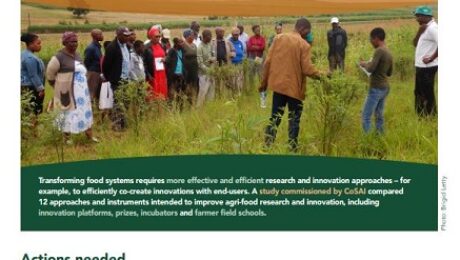
Transforming food systems requires more effective and efficient research and innovation approaches – for example, to efficiently co-create innovations with end-users. A study commissioned by CoSAI compared 12 approaches and instruments intended to improve agri-food research and innovation, including innovation platforms, prizes, incubators and farmer field schools.
- Published in EXTENSION AND INNOVATION
A systemic approach to the decolonisation of knowledge

The authors employ a systems perspective to investigate how coloniality is manifested in the current academic knowledge system and how we can make progress toward the ‘decolonisation of knowledge.’ We reflect on how individual scholars, located in Western donor countries, who benefit from the coloniality of the current knowledge system, can undermine and contest this coloniality with their research and activism. Although we recognise that decolonisation is an ethical issue, we contend that cognitive diversity represents progress and improvements to our pool of knowledge.
- Published in EXTENSION AND INNOVATION
Joint rapid appraisal on strengthening agricultural innovation systems in Africa, Asia and Latin America – Synthesis Report 2021
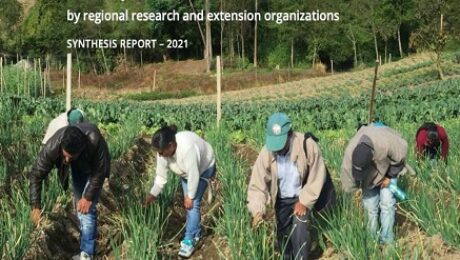
This report summarizes studies conducted in a framework of TAP-AIS project implemented by FAO’s Research and Extension Unit, and funded by the European Union as a component of the European Union initiative on “Development Smart Innovation through Research in Agriculture” (DeSIRA). The studies were conducted by consultants and staff at the regional research and extension organizations in Asia, Africa and Latin America, namely the Asia-Pacific Association of Agricultural Research Institutions (APAARI), Asia-Pacific Islands Rural Advisory Services Network (APIRAS), Forum for Agricultural Research in Africa (FARA), African Forum for Agricultural Advisory Services (AFAAS), Latin American Network of Rural Extension Services (RELASER) and Forum of the Americas for Agricultural Research and Technology Development (FORAGRO)/ Inter-American Institute for Cooperation on Agriculture (IICA).
- Published in EXTENSION AND INNOVATION
StrategIES For Scaling Agricultural Technologies in Africa
This report is intended as aid to disseminating the valuable lessons and findings adduced at the “Strengthening Capacity for Agricultural Innovation in Post-conflict and Protracted Crises (2PC) Countries: A Consultative Learning Workshop” held in Kigali, Rwanda, 6 – 8 September 2012, especially by the workshop participants back in their home countries. The report deliberately outlines the learning process adopted during the workshop. Documenting the process is equally important as documenting the results so that subsequent workshops or engagements of a similar nature may benefit from the outlined methodology. Starting with background information, the report presents a summary of the plenary presentations of the workshop, which includes a brief on the post-conflict and protracted crisis environment in the 15 participating countries. A section is thereafter dedicated to process steps that eventually led to the final action plan. An immediate outcome of the final action plan was a synthesis paper presented to the “High Level Expert Forum: Addressing Food Insecurity in Protracted Crises” jointly convened by the Committee on World Food Security and FAO on September 13 – 14 in Rome, Italy. The synthesis paper will also form the basis for a presentation during the 2 nd Global Conference on Agricultural Research for Development (GCARD 2) to be held in Punta del Este, Uruguay on 29 Oct – 1 Nov 2012.
- Published in EXTENSION AND INNOVATION
Common Framework on Capacity Development for Agricultural Innovation Systems | CONCEPTUAL BACKGROUND

The Tropical Agriculture Platform (TAP) is a G20 initiative with strategic goal of contributing to the development of national capacities for agricultural innovation in the tropics and the objective of enhancing “Capacity Development” (CD) in “Agricultural Innovation Systems” (AIS). As stated in the TAP “Theory of Change”, the “TAP capitalizes on and adds value to on-going initiatives by fostering greater coherence of capacity development interventions in tropical agriculture, strengthening interaction for more harmonized action and greater mutual accountability, and avoiding duplication”.
One of the first tasks of TAP is therefore to facilitate the emergence of a common language and a shared understanding of the scope of the challenge. Most countries and Development Partners (DP) use their own terminology and a lot of time is lost in trying to understand the exact meaning of the words used. A few examples: Are “capacity development”, “capacity strengthening” and “capacity building” synonymous? What is meant by “Agricultural Innovation Systems” (AIS)? Is there a general agreement on the three “levels” usually identified in the field of capacity development” (CD), i.e. individual, organisational and institutional/system? How are defined the CD recipients/targets for each of these levels?
- Published in EXTENSION AND INNOVATION, GUIDE/TOOLS/MANUALS
Common Framework on Capacity Development for Agricultural Innovation Systems | GUIDANCE NOTE ON OPERATIONALIZATION

Agricultural innovation is critical for increasing agricultural productivity as well as for sustainability of agricultural systems. Innovation, however, cannot rely solely on spin-offs from foreign research. It requires endogenous capacities to generate, systematize, and adapt knowledge as well as to adopt and up-scale new practices.
An Agricultural Innovation System (AIS) is a network of actors or organizations, and individuals, together with supporting institutions and policies in the agricultural and related sectors, which bring existing or new products, processes, and forms of organization into social and economic use. Policies and institutions (formal and informal) shape the way that these actors interact, generate, share and use knowledge as well as jointly learn.
Capacity Development for Agricultural Innovation Systems (CD for AIS) enables joint learning and co-creation and new uses of knowledge for social change and enhances the interactions between actors. It is also about creating an enabling environment for such interaction, learning and innovation, based not only on conducive formal law and regulations, but also on informal values, attitudes and behaviours. It aims at changing people’s behaviour and developing of more sustainable practices that bring about societal transformation.
- Published in EXTENSION AND INNOVATION, GUIDE/TOOLS/MANUALS
Common Framework on Capacity Development for Agricultural Innovation Systems

Innovation in agriculture is a precondition for meeting the challenge of feeding the world’s growing population in the face of a changing climate and degrading natural resources. It is fundamental to achieving the Sustainable Development Goals of ending poverty and hunger, achieving food security, improving nutrition and promoting sustainable agriculture. Innovation also has a role to play in achieving gender equality, ensuring healthy lives for all and contributing to economic growth. Many countries are however not fully exploiting their innovation potential. In order to do so, they must strengthen the capacity of individuals and organizations, create an enabling environment and, crucially, reinforced or make more effective Agricultural Innovation Systems (AIS).
AIS, may be defined as complex networks of actors (individuals, organizations and enterprises), together with supporting institutions and policies that bring existing or new agricultural products, processes, and practices into social and economic use.
In 2012, the Agriculture Ministers of the G20 called for the creation of a Tropical Agriculture Platform (TAP) to promote the development of national capacities for agricultural innovation in the tropics, where almost all low-income countries are located. The aim of TAP is to enhance the overall performance of AIS, with particular focus on small- and medium-scale producers and enterprises in the agribusiness sector. TAP’s ultimate objective is to make agriculture more sustainable and improve livelihoods.
- Published in EXTENSION AND INNOVATION, GUIDE/TOOLS/MANUALS