
Evaluation of the project “Increasing smallholder productivity and profitability”
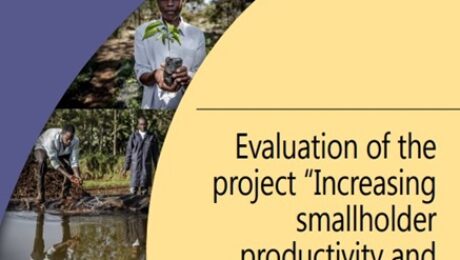
FAO’s “Increasing smallholder productivity and profitability” (ISPP) project funded by the United States Agency for International Development (USAID) and implemented by FAO in Kenya had the objective to improve livelihoods through enhanced productivity, market linkages and better nutrition. The evaluation assessed the relevance of the project and the achievement and sustainability of results. The evaluation found increased technical capacity among farmers, but significant limitations to apply the knowledge. Increased access to diverse types of fruits and vegetables at household level was reported. Anecdotal evidence shows change of dietary habits. Farmers were trained on contract farming, negotiation skills, marketing strategies, financial access and agro-entrepreneurship, but access to markets remained a challenge across all value chains promoted, and equitability of support services could not be established. For future, similar projects, the recommendations include i) the establishment of a community-based collaboration platform to foster long-term sustainability; ii) framework and guidelines for gender mainstreaming; iii) enhancing operational transparency and adaptive management; iv) exit strategy with sustainability action plan; v) comprehensive support for access to markets; and vi) focus on monitoring, learning and evaluability when designing and implementing reporting mechanisms.
- Published in MONITORING & EVALUATION
Good practices for monitoring and evaluation of national phytosanitary systems
This publication seeks to support practitioners by providing methodological guidelines for conducting rigorous impact assessments of Home Grown School Feeding (HGSF) programmes. It presents an overview of the main technical issues to be addressed depending on the characteristics of the context and of the intervention itself. While these guidelines are mainly designed for monitoring and evaluation officers working for United Nations agencies, local governments or non-governmental organizations, its contents can be of interest to a wider audience of policymakers, researchers and practitioners interested in multi-sectoral, complex programmes linking agriculture and nutrition.
- Published in MONITORING & EVALUATION
Impact evaluation of home-grown school feeding programmes

This publication seeks to support practitioners by providing methodological guidelines for conducting rigorous impact assessments of Home Grown School Feeding (HGSF) programmes. It presents an overview of the main technical issues to be addressed depending on the characteristics of the context and of the intervention itself. While these guidelines are mainly designed for monitoring and evaluation officers working for United Nations agencies, local governments or non-governmental organizations, its contents can be of interest to a wider audience of policymakers, researchers and practitioners interested in multi-sectoral, complex programmes linking agriculture and nutrition.
- Published in MONITORING & EVALUATION
Evaluation of “Monitoring and Analysing Food and Agricultural policies – Phase II”
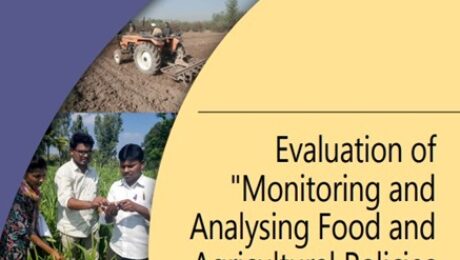
Governments have turned to FAO for support in identifying and assessing options for reforming policies on food and agriculture through the “Monitoring and Analysing Food and Agricultural Policies” (MAFAP) programme. While the first phase of FAO’s efforts concentrated more on conducting policy analysis and measuring public expenditures, this second phase built on the first phase’s outcomes to support policy reforms across Southern Asia and sub-Saharan Africa. MAFAP has been found to be an effective and well-positioned influencer of policy reforms in the agricultural sector. However, there are areas of improvement for this programme, including: i) increased resources to better address increasing policy support demand; ii) more strategic planning; iii) more formal institutionalization and more engagement with civil society and the private sector; iv) more coherence at country level in conducting preliminary analysis; and v) improvement to its knowledge management system in order not to lose its institutional memory.
- Published in MONITORING & EVALUATION
Evaluation of the project “Integrated national monitoring and assessment system on forest ecosystems (SIMEF)

Chile has a native forest that constitutes 18 percent of its continental surface area and over 60 million hectares of protected areas. The country is considered a global hotspot of conservation priority due to its endemism and a high degree of habitat loss. The loss of ecosystems could increase if economic development does not progressively adopt sustainability standards that create less of an impact on biodiversity. From August 2015 to May 2020, FAO implemented the project in order “to develop and implement an integrated monitoring and assessment system on carbon stocks and biodiversity in forest ecosystems (SIMEF) supporting the National Greenhouse Gases Inventory (INGEI) and the design of policies, regulations and SFM practices incorporating the REDD+ Programme and biodiversity conservation in forest ecosystems”. The project established sound foundations that improve the monitoring of the conditions of forest ecosystems and, consequently, more robust information is generated and with greater frequency. It is worth highlighting the creation of an interinstitutional structure that will support the continuity of the SIMEF and the creation of a digital platform with five tools. The SIMEF is, at present, a regular programme of the Chilean State with a governance system and with a permanent annual budget. Given this, the sustainability of the achievements made in the project can be maintained and strengthened. However, a low level of appropriation of the system at local level was identified, which could affect its sustainability.
- Published in MONITORING & EVALUATION
Review of monitoring and evaluation capacities in the agriculture sector
Evaluation and results-based management are amongst the best-known instruments to strengthen accountability and learning, and ultimately improve policies and practices. How are these instruments applied by Ministries of Agriculture, and are officials working in this sector equipped with adequate capacities and resources to carry out the evaluation? This report summarizes the results of a study which aimed to shed some light on these questions. The role of the Ministry of Agriculture in assessing results for sectoral public policies or programmes varies greatly between countries. Essentially, the M&E units in Ministries of Agriculture are mostly engaged in monitoring, with evaluation being quite rare. This raises the need to support M&E units to fulfill their mandate by playing a role in measuring results and drawing lessons to improve interventions in the sector and contributing to monitoring and evaluation of national policies and strategies, including the SDGs. The study was carried out over a six-month period through interviews with officers working in M&E units in 23 countries by the FAO Office of Evaluation (OED) in collaboration with EvalForward, a community of practice on evaluation for food security, agriculture, and rural development.
- Published in MONITORING & EVALUATION
Monitoring and evaluation of child labour in agriculture
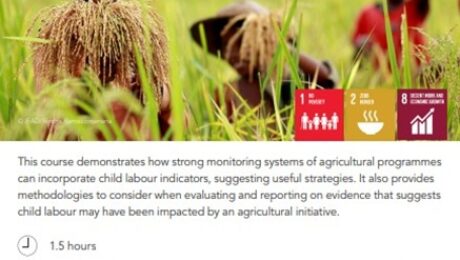
This fact sheet describes the course that demonstrates how strong monitoring systems of agricultural programmes can incorporate child labour indicators, suggesting useful strategies. It also provides methodologies to consider when evaluating and reporting on evidence that suggests child labour may have been impacted by an agricultural initiative.
- Published in MONITORING & EVALUATION
Mid-term evaluation of the project “Monitoring water productivity
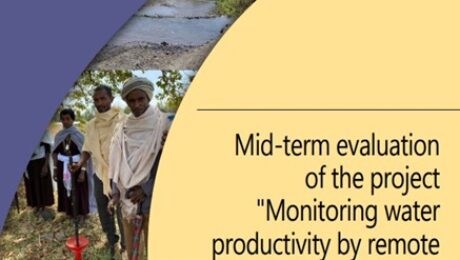
While population growth and economic development are putting unprecedented pressure on renewable, but finite water resources, especially in arid regions, scarce land and water resources are affecting food security and sustainable water management. FAO identified the need to implement a digital database built upon remote sensing and information technologies that can monitor and report on agricultural water productivity over Africa and Near East, accessible through the FAO Water Productivity through Open access of Remotely sensed derived data portal (WaPOR). The WaPOR database is now operational at continental level (all African and Near East countries covered by the 250 m spatial resolution data), national level (two beneficiary countries can access the WaPOR database at 100 m resolution) and subnational level with a spatial resolution of about 30 m, so far including eight areas of interest (river basins or irrigation schemes). Water Accounting Plus (WA+) reports based on remote sensing have been completed for three river basins as planned (Litani in Lebanon, Awash in Ethiopia and Jordan basin). An action framework at national level for capacity building and participatory decision making is currently being developed to make effective a “demand-driven” approach based on national and local needs.
- Published in MONITORING & EVALUATION
Development of Halal Agricultural Production Systems in Mindanao, Philippines
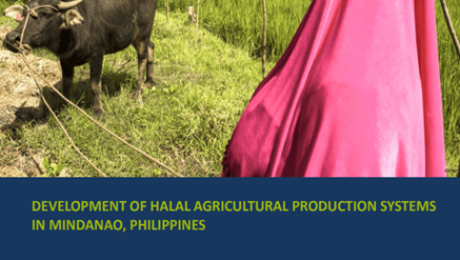
The economy of Mindanao is dominated by the agriculture sector. With one-third of its land area devoted to agriculture, the island has been tagged as the country’s food basket. The majority of the country’s total production of high-value commodities, such as rubber, pineapple, banana and coffee, comes from Mindanao. It also supplies over 40 percent of the country’s food requirements and contributes more than 30 percent to the national food trade. The Department of Agriculture (DA) continues to stimulate productivity and gain wider market niches by harnessing emerging global opportunities for local producers. One such opportunity is the growing global market for Halal foods, known to be worth USD 2.95 billion for meat alone, which other non-Muslim countries such as Thailand, Australia, Brazil and Belgium have already successfully entered. In the 2004-2010 Medium Term Philippine Development Plan, Mindanao was cited as the part of the country most suited to the development of the Halal industry. The plan identified the Autonomous Region in Muslim Mindanao (ARMM), the only region with Muslim identity, as the focal area for Halal development. The Philippine Development Plan (2017-2022) aims to expand the economic opportunities of those currently engaged in producing agriculture, forestry and fisheries products and, at the same time, increase access to economic opportunities for small farmers and fishers in order to achieve inclusive growth. The government will also continue to promote climate change adaptation measures, organic agriculture, urban agriculture and Halal food production.
- Published in VALUE CHAIN / MARKETS
Scaling up inclusive innovations in agrifood chains in Asia and the Pacific

The publication looks at innovations happening at all stages of the food value chain: from production to manufacturing and retailing. This also includes the extended value chain, for example input supply, financial services and agribusiness support services. Yields are improving and primary production is becoming more resilient as a result of digital technologies such as precision agriculture, agricultural drones, and digital farming services and marketplaces; and novel business models such as plant factories, crowdsourcing for farmers. Data and robotics help lift productivity and food safety in the manufacturing process. Online grocery commerce and food delivery services are revolutionizing the way consumers purchase food. Distributed ledger technology, such as blockchain, allows making payments and tracing back food products along the chain in order to increase transparency and trust. New business models are springing up to shorten the chain by removing or shifting stages and to make it fairer and greener, stimulated by enabling technologies and changing customer behaviours. Innovations such as these are discussed and illustrated by almost 200 practical examples from 21 countries in the Asia-Pacific region, across various types of firms and commodities.
- Published in ICTs, VALUE CHAIN / MARKETS