
The evolution of agricultural mechanization in Sri Lanka
Sri Lanka’s unique geography and its distinct experiences with machine use in rice and field crop production offer valuable insights into different patterns of mechanization. Rice in Sri Lanka has a substantial irrigation infrastructure, a strong plant breeding system, and historical examples of success in location-specific breeding strategies (Pain 1986). Furthermore, tractor use in rice cultivation grew very quickly, especially given the relatively small amount of arable land in the country and the lack of direct subsidies, but with certain incentives. Though mechanization initially spread for paddy cultivation, machinery has also become popular in varying degrees in the production of other field crops. This chapter explores the spread of mechanization in Sri Lanka, with a focus on the use of four- and two-wheel tractors, and combine harvesters. It first looks at the process of mechanization from a historical perspective. It then conducts demand- and supply-side analysis to identify the opportunities and challenges facing adoption of machinery in agriculture. It concludes with a brief discussion of the implications of the Sri Lankan experience for African countries starting the process of mechanization.
- Published in SRI LANKA
The People Behind Your Plate

The book is organized around the “5 Ps” of people, planet, prosperity, peace and partnerships. The work that rural people do, including growing food and taking care of precious natural resources, is at the heart of the 2030 Agenda.
The Sustainable Development Goals outline 17 areas for eliminating poverty and hunger, protecting the planet, and promoting peace and prosperity. These priorities are fundamental to the transformation of rural areas. The stories in this book show how IFAD invests in rural people to support their efforts, knowledge and skills as they help solve some of the world’s most urgent challenges.
- Published in PRIVATE SECTOR EXTENSION /PPP
Co-creating Sustainable Livelihoods in India

The livelihoods sector has undergone a significant transformation over the past decade and is expected to see even greater shifts over the coming years, given the unprecedented times that stand ahead of us. Livelihoods are a critical pathway to eliminating poverty and driving sustainable economic growth for communities. It is thus crucial to bring forth opportunities that have potential to transform systems that create sustainable livelihoods across the value chain, despite the dynamically evolving challenges. It is important to anticipate that collaboration and co-creation are the most critical enablers of sustainable livelihood in rural and urban India. Not only does it preserve the resources involved in re-invention, it also allows us to leveraging cross sectoral expertise & enables collective action to achieve impact at a large scale.
Keeping this very idea at its heart, the India Livelihoods Collective has undertaken numerous initiatives since its inception, providing a collaborative platform for diverse organisations to come together in catalysing the process of achieving livelihoods goals in India. Extending its efforts in this direction, this document provides specially curated 45 livelihoods practices initiated by Corporates, NGOs, Impact Investors, Start-ups, Academia and other enablers in the livelihoods ecosystem. The compendium maps the avenues for collaboration to scale-up and replicate these practices, highlighting the challenges, key learnings, livelihoods outcomes and impact on livelihoods sustainability.
- Published in INDIA
Syngenta Foundation for Sustainable Agriculture Farmers’ Hub Impact Insights Bangladesh

The Syngenta Foundation for Sustainable Agriculture was established in 2001 to improve the livelihoods of smallholder farmers in poorer regions of the world. Since its beginnings, the Foundation has been instrumental in delivering sustainable agriculture initiatives for pre-commercial smallholders.
In recent years Syngenta Group has been strengthening its own strategic efforts to support commercial smallholders with innovative and transformative solutions. This includes improved access to products, agronomic training, and markets, and a large network of agricultural centers across China, Africa, Asia, and Central America.
- Published in BANGLADESH
Scaling Readiness- Concepts, Practices, and Implementation

Scaling Readiness supports organizations, projects, and programs in achieving their ambitions to scale innovations. Scaling Readiness encourages critical reflection on how ready innovations are for scaling and what appropriate actions could accelerate or enhance scaling. Scaling Readiness treats innovation as a flexible package of technological, organizational, and institutional components that may include crop varieties, machines or equipment, crop production practices, legislation, and marketing campaigns.
An innovation may be ready in a technical sense – for example, a new crop variety may thrive in the local environment – but, if farmers lack funds to buy seed or if the policy environment discourages the uptake of new varieties, it may not be adopted at scale. Scaling Readiness assesses the potential of innovations to be used at scale and guides research and development intervention managers in implementing these innovations in practical contexts. Through its standardized data collection and analysis approach, Scaling Readiness can also be used to monitor an intervention portfolio at organizational level, allowing for evidence based management.
- Published in CONCEPTS AND PRACTICES
12 Things to Consider When Starting an Agritourism Business
Agritourism is a business venture on a working farm, ranch or agricultural enterprise that blends entertainment, education and tourism to provide a fun, exciting and memorable experience for people of all ages. Because it is a business, structure the venture using the same guidelines you would for any other bricks-and-mortar or online business.
Most agritourism businesses are diversifications of existing businesses. If someone has a farm, he or she may open the farm for educational field trips for children. The farm may have a pumpkin patch, a U-pick operation or a Christmas tree plantation. Landowners with a pine plantation may consider building a cabin in the woods for overnight stays that include horseback riding or fishing in a pond.
- Published in AGROTOURISM
Getting Started in Agritourism
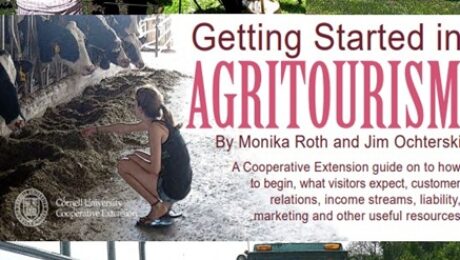
There is a great deal of interest in agritourism as a niche tourism sector for farms. People are looking for an authentic farm experience that might link them to their past or that teaches them something new. Visitors also want relief from the stress of everyday life to experience a seemingly simpler life. Farm visits offer a day in the country, where guests may pick berries, go for a hayride, sample
homegrown or homemade products, see animals, and learn how farms operate.
READ MORE
- Published in AGROTOURISM
A Guide to Successful Agritourism Enterprises
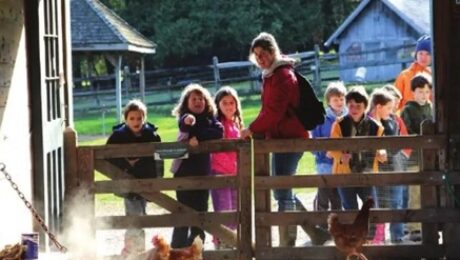
Agritourism activities are becoming an important component of many farm operations. These activities have the potential to increase farm revenues and maintain the sustainability of the industry. However, agritourism activities won’t suit every farm or farmer. Before starting an agritourism operation, it is recommended that farmers spend some time assessing the potential that these activities have for their operation, and carefully planning the business and marketing elements of their operation. This guide will help with all the planning that goes into running successful agritourism operations.
- Published in AGROTOURISM
Responsible Rural Tourism in Asia

The rural tourism sector has become a key driver for social and economic growth and a major source of income for developing and low-income countries in many parts of Asia. Rural tourism is progressively viewed as a solution, increasing the economic viability of marginalised areas, stimulating social regeneration and improving the living conditions of rural communities. Responsible rural tourism promotes conservation of the natural environment, protects the authenticity of culture, and offers socioeconomic opportunities and benefits for local communities. This book encompasses case studies from a range of Asian countries and examines both successful and failed attempts in developing responsible rural tourism, and the learnings that we can adopt and adapt for future responsible rural tourism in the region. It will be of interest to students, researchers, stakeholders and policymakers in tourism.
- Published in AGROTOURISM
Innovations in Agritourism: Evidence from a Region in Poland
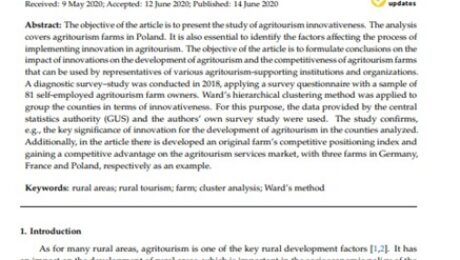
The objective of the article is to present the study of agritourism innovativeness. The analysis covers agritourism farms in Poland. It is also essential to identify the factors affecting the process of implementing innovation in agritourism. The objective of the article is to formulate conclusions on the impact of innovations on the development of agritourism and the competitiveness of agritourism farms that can be used by representatives of various agritourism-supporting institutions and organizations. A diagnostic survey–study was conducted in 2018, applying a survey questionnaire with a sample of 81 self-employed agritourism farm owners. Ward’s hierarchical clustering method was applied to group the counties in terms of innovativeness. For this purpose, the data provided by the central statistics authority (GUS) and the authors’ own survey study were used. The study confirms, e.g., the key significance of innovation for the development of agritourism in the counties analyzed. Additionally, in the article there is developed an original farm’s competitive positioning index and gaining a competitive advantage on the agritourism services market, with three farms in Germany, France and Poland, respectively as an example.
- Published in AGROTOURISM