
Aggregation models and small farm commercialization – A scoping review of the global literature
Aggregation models where small farms jointly access credit, inputs, information, and product markets are not new to global agricultural systems. For over a century, agricultural cooperatives worldwide have tried rectifying small farm disadvantages in market access. In the last two decades, newer aggregation models such as farmer producer organizations, farmer groups, enterprises, and companies have increased. This scoping review assesses the taxonomy of aggregation models, identifies factors responsible for their re-emergence, analyzes their benefits to smallholders, and pinpoints the research gaps in the literature. The review finds that in erstwhile socialist economies, cooperatives emerged as a means of voluntary aggregation following decollectivization from the 1980s onwards. In countries that traditionally had cooperatives, newer aggregation models emerged as cooperatives faltered in adapting to market transformations. The new aggregation models focused on higher-value horticulture crops, livestock, dairy, and cash crops, in line with changing markets and demand. While identified qualitative and quantitative studies showed that aggregation models improved access to factor markets for credit, technology, and extension services, joint selling remained relatively low. Although many studies reported household welfare gains; studies assessing the organizational performance of aggregation models were fewer in number. The review’s limitations were that it mainly identifies studies in English (and some Spanish) and evaluated only successful aggregation models, pointing to a survivorship bias in the literature. Long-term studies of aggregation models utilizing panel data and robust design to infer causation and multiple case studies to uncover the heterogeneity of aggregation models are crucial.
- Published in PRODUCER ORGANISATION
Family Farmers’ Cooperatives: Ending Poverty and Hunger in South Asia
Family farming is an integrated farming system, which produces diverse agricultural commodities that significantly contribute to improve food and nutrition security and income of the poor and marginalized group of people in the rural areas. As the reduced level of the economies of scale is a major challenge encountered by family farmers in the South Asia that could be addressed by farmers’ cooperatives approach. Strengthening the farmers’ cooperatives would increase the economies of scale that reduce the cost per unit in production and marketing of the products, and eventually support to improve food security, increase income and reduce poverty. This paper is based on the secondary data and literature review. Ending poverty and hunger targets of the Sustainable Development Goals (SDGs) by 2030 is possible through strengthening the family farmers’ cooperatives in South Asia by adopting some major policy interventions. Such interventions include: i) Effective implementation of the South Asia regional plan of action of UN Decade of Family Farming (UNDFF); ii) Increase the public and private investment in family farming and farmers’ cooperatives; iii) Emphasize the multidimensional approach of program implementation to the poor and marginalized people; iv) Promotion of Future Smart Food System such as nutrition sensitive agriculture and the utilization of neglected and underutilized nutrition rich crops; and v) Effective coordination and cooperation among different agencies at the country level (local, sub-national, and national levels), development partners, South-South counties, and North-South countries to contribute in attaining the targets of Sustainable Development Goals, particularly the No Poverty and Zero Hunger through farmers’ cooperatives in South Asia.
- Published in BANGLADESH, BHUTAN, INDIA, MALDIVES, NEPAL, PAKISTAN, PRODUCER ORGANISATION, SRI LANKA
Policy Implementation: Insights from an E-survey on Operational Guidelines for 10,000 FPOs
The purpose of the Working Paper Series (WPS) is to provide an opportunity to IRMA faculty, visiting fellows, and students to sound out their ideas and research work before publication and to get feedback and comments from their peer group. Therefore, a working paper is to be considered as a pre-publication document of the Institute. This is a pre-publication draft for academic circulation and comments only.
- Published in PRODUCER ORGANISATION
Farmer Producer Companies: Past, Present and Future

Eighty-seven percent of agricultural households in India are small and marginal producers, cultivating small plots which generate low returns. Their average monthly income is Rs 6426, making farming on small plots economically unviable (NSSO 2014). Therefore, policy makers and practitioners are turning to producer collectives as a means for improving the economic situation of small producers.
- Published in PRODUCER ORGANISATION
State of Agricultural Extension reforms in India and the need of convergence
Extension reforms play a significant role in catalysing the extant policies and provisions that are affecting the extension service across India. Although the country has seen a series of reforms in the past seven decades, the changing contours of agriculture over the years demand new sets of interventions and reform measures. Regimes in the past decades have brought a series of measures to strengthen the extension system. The present study found that the most of the reforms were concentrated on a single theme and even the multiple reforms were overlapping with similar mandates. This resulted in poor performance and poor accessibility to the needy households. Moreover, during the pandemic the existing system reforms showed a fair amount of refinement. Therefore, the study highlights the importance of convergence across common themes of various interventions brought in to enhance the extension services.
- Published in EXTENSION AND INNOVATION, POLICY
School Food and Nutrition – Global Action Plan 2022–2026

This publication is the result of a collective effort, and includes contributions from relevant technical units of FAO across global, regional and country levels. The development of this plan follows the publication and dissemination of the Organization’s School Food and Nutrition Framework, and provides the implementation roadmap to attain its expected results.
The School food and nutrition – Global action plan seeks to consolidate and guide FAO’s synergistic efforts, setting out priority and concrete outputs to be achieved by 2026. Key activities are presented in the plan and organized according to the following action areas: 1. promote the uptake of and investment in holistic approaches to school food and nutrition (SFN); 2. enhance capacities to design, implement and monitor effective SFN interventions; 3. strengthen policy and legal frameworks that enable SFN implementation; and 4. mobilize resources for ensuring regular and better support to countries. These have been prioritized based on identified gaps and needs, and considering the Organization’s technical competence and organizational comparative advantage. Such activities are meant to be adapted, contextualized and implemented according to regional and national priorities.
READ MORE
- Published in POLICY
Gender, tenure security, and landscape governance
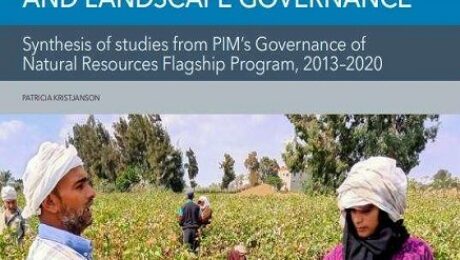
Gender relations shape women’s and men’s identities, norms, rules, and responsibilities. They influence people’s access to, use, and management of land and other natural resources, including ownership, tenure, and user rights to land and forests. A substantial body of research on these issues comes from the CGIAR Research Program on Policies, Institutions, and Markets (PIM), through its Flagship 5 research theme. Flagship 5 focused on gender and social inclusion in relation to land and natural resource tenure and to landscape governance, and analyzed how tenure security affects sustainable management of land, water, fish stocks, and forests. This Food Policy Report reviews the scientific contributions from Flagship 5 to the broader wealth of related literature, including key lessons about gender from these studies with respect to outcomes and impacts on natural resource management, food security, and poverty alleviation.
- Published in GENDER
Research Series 73: Food systems and rural wellbeing: challenges and opportunities

This paper provides a framework for assessing the dynamics of rural wellbeing and food systems change. It provides a synthesis of over 840 recommendations made in recent international reports on the linkages between food systems and rural development. It also looks at the viability of small-scale farming and the diversification of livelihood options needed to overcome rural poverty and inequality.
- Published in POLICY
Repurposing Agricultural Policies and Support

The report finds that repurposing a portion of government spending on agriculture each year to develop and disseminate more emission-efficient technologies for crops and livestock could reduce overall emissions from agriculture by more than 40 percent. Meanwhile, millions of hectares of land could be restored to natural habitats. The economic payoffs to this type of repurposing would be large. Redirecting about $70 billion a year, equivalent to one percent of global agricultural output, would yield a net benefit of over $2 trillion in 20 years.
- Published in POLICY
Increasing stakeholder participation in forest law reform process-Case studies from FAO-EU FLEGT Programme

The FAO-EU FLEGT Programme is carrying out an experience capitalization exercise to collect, analyse and share experiences, good practices and lessons learned during the implementation of the Phase III of the Programme. As a part of this effort, the Programme agreed to support the project entitled “Increasing Stakeholder Participation in Forest Law Reform Process: Case Studies from FAO-EU FLEGT Programme”. This project, carried out and co-financed by ClientEarth, includes a review of nine projects that focused on increasing stakeholder participation in legal reform processes in the following countries: the Republic of Congo, Cote d’Ivoire, Liberia, Malaysia, Myanmar and the Philippines. The publication includes the aggregate findings of the six focus countries, general analysis and recommendations.
- Published in POLICY